
Where this started (and why it didn’t make sense)
When I was pregnant with my son, Jasper, I was already working in the functional gut health space. I understood how much the microbiome matters, especially in those early stages of life. I hadn’t taken antibiotics in nearly a decade. He was born vaginally, breastfed, and never exposed to medications.
From every angle I understood at the time, I had set him up well to prevent something like eczema from developing.
So when I noticed a small patch on his chest around nine months old, it didn’t immediately alarm me. It wasn’t red or inflamed. It didn’t seem to bother him. It was just a slightly rough, uneven patch that felt… different.
Still, something about it didn’t sit right with me. I trusted that instinct and started asking questions early.
What I didn’t realize then was how familiar this path would become- not just for me, but for so many of the families I now work with.
What we tried first (and why it failed)
We started where most people do.
I went to a naturopath locally first. They thought it could be a fatty acid deficiency, so we added cod liver oil, but just to be safe also suggested we start a probiotic.
And that’s when everything shifted.
The small patch didn’t just stay the same. It spread and it spread fast. What had felt mild and manageable turned into something much more aggressive. His skin became reactive, unpredictable, and it started covering more and more of his body.


At that point, I went into full problem-solving mode.
I changed our laundry detergent. I switched him to all organic cotton clothing. I bought every “clean” cream I could find. Because I was breastfeeding, I began removing foods from my own diet, trying to trace any possible trigger. I was tracking everything and every day I was trying to figure out what we did differently that caused the day’s flare.
I was doing all the things that are commonly recommended, and I was doing them carefully.
And still, nothing was improving in a meaningful or lasting way.
The moment everything changed
As things got worse, I took him to see our integrative pediaitrician and she actually agreed with me that this was a sign of a gut health imbalance. She suggested we have him tested for allergies to be sure it wasn’t that and agreed that the cod liver oil and probiotic he was taking were the right choice. He was 11 months old and having his blood drawn broke my heart in so many ways. I remember waiting for the allergy results and feeling hopeful that we would finally have something clear to work with.
Then they come back with no allergies. Nothing. I felt both relieved and completely stuck at the same time.
There was no clear answer. No explanation.
I got on a telehealth call immediately with the pediatrician and she was out of ideas and wanted to refer us to a dermatologists to get a topical steroid, even though I had told her I wasn’t comfortable with that option. Oh and by the way, we wouldn’t be able to get in with the dermatologist for two months.
I was running functional labs on adults and I told her I was going to order a stool test to look at his microbiome and a urine toxin test to rule anythig out while we waited.
I’ll nevere forget sitting across from her and hearing her say, “You won’t find anything on testing. There’s no cure for eczema. He’s too young to have any toxin burden. Just go see the dermatologist.”
It was then that I knew I was on my own to figure it out because no one was interested in finding out what was actually happening in his body the way that I was.
Spoiler: the pediatrician was wrong…
What we found
I decided to run more comprehensive testing, including a stool test and a toxin panel because they were non-invasive and didn’t require a blodo draw on my then 1 year old baby. When those results came back, everything started to make sense in a way it hadn’t before.
His gut showed significant disruption. There was clear bacterial overgrowth, clues about parasitic overgrowths, inflammation, and signs that his immune system was highly activated in his digestive tract. There were even markers indicating irritation within the lining of his gut. To this day his stool results are some of the worst I have ever seen for a child and his Calprotectin levels were maxed out above 3000, meaning he would have likely be diagnosed with instestinal bowel disease.


At the same time, his toxin panel revealed something I hadn’t fully considered in this context.
We shared exposures, which made sense because he was breastfed. The highest contributors were mercury as well as a number of mycotoxins which are toxins produced by mold. I was completely assymptomatic and healthy and had no idea that these toxins were impacting my body, let alone his.
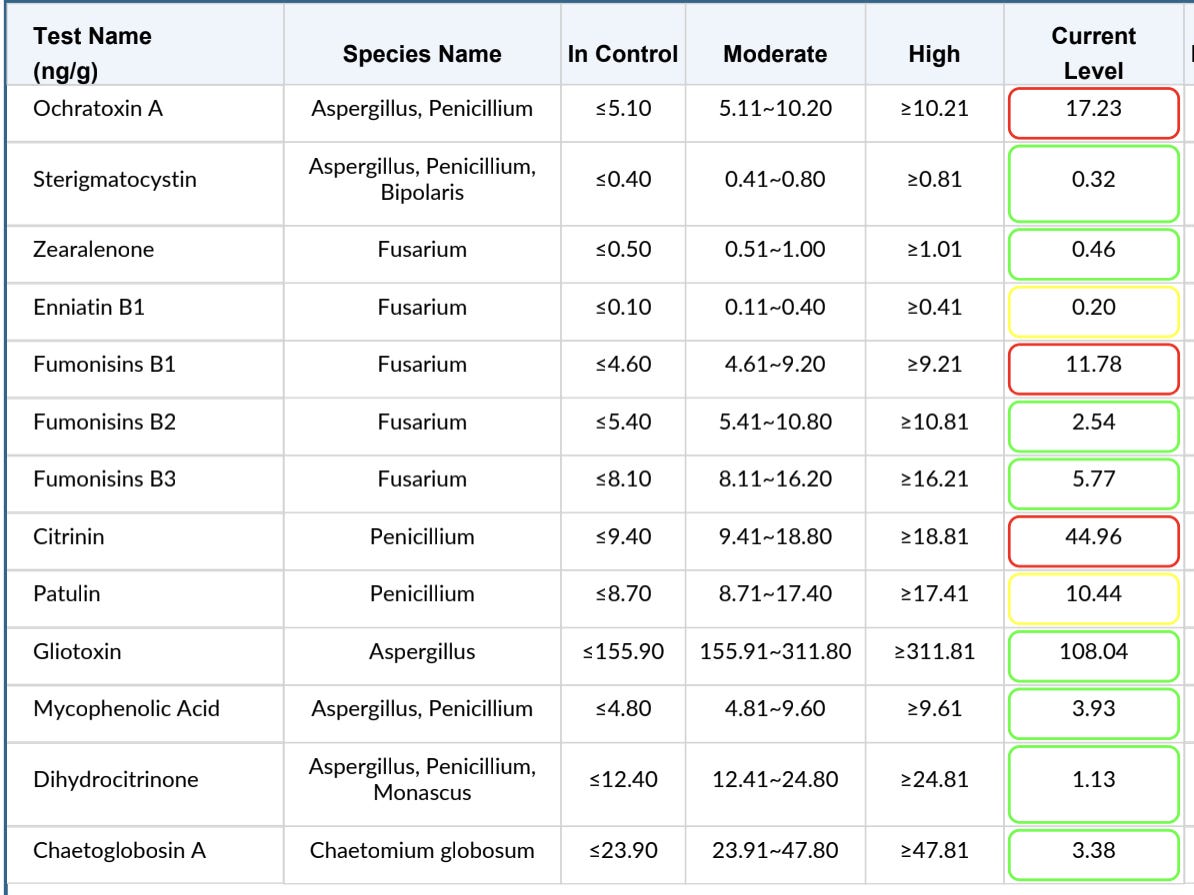
Seeing those two pieces together (gut dysfunction and toxin burden) changed how I understood what was happening.
The piece that changed everything for me
We spend so much time thinking about what babies are exposed to after they’re born. What we don’t talk about nearly enough is what they receive from us before they ever take their first breath. That was the moment I realized something I had never been taught in this way: I hadn’t just passed on my microbiome. I had also passed on part of my own toxic load and no one had ever told me that this could happen or influence my baby’s gut health and immune system.
That realization reframed everything for me, not just as a practitioner, but as a mother.
Why mold became an important part of the story
When people hear “mold,” they often think of something visible, something obvious in a home, but what we’re often dealing with clinically are mycotoxins, compounds that can remain in the body and influence how the immune system behaves.
In adults, this kind of burden often shows up in ways that feel disconnected: fatigue, brain fog, hormone issues, difficulty recovering from stress.
In children, it tends to look different. It can show up through the skin. Through sleep. Through behavior. Through patterns that don’t quite make sense until you start looking at the body as a whole system.
And one of the reasons this becomes so significant in children is that their bodies are still developing the ability to process and eliminate what they’re exposed to.
Their detox pathways aren’t fully mature. Their systems are still learning how to regulate, filter, and clear.
So when there’s more coming in than going out, the body adapts.
What the body does when it can’t keep up
When internal pathways of elimination aren’t keeping pace, the body doesn’t simply hold onto everything indefinitely. It looks for other ways to manage that load.
The skin is one of those ways. This was one of the biggest shifts for me in understanding eczema. Instead of seeing it as something happening randomly on the surface, I began to see it as part of a larger pattern, something the body was doing in response to internal stress.
Another layer we didn’t initially see: histamine
As we dug deeper, another pattern became clear.
His system wasn’t just inflamed… it was reactive.
Histamine plays a significant role in how the body expresses inflammation, especially through the skin. It influences itching, redness, and the intensity of flares.
When I looked back, I realized that the probiotic we had introduced early on contained strains that can contribute to histamine production in certain individuals. At the time, it seemed like a supportive step. In his case, it added another layer to an already overwhelmed system.
I wasn’t told that many strains of probiotics are actually histamine producing, which was adding to the problem including:
Lactobacillus casei
Lactobacillus delbrueckii subsp. bulgaricus
Lactobacillus helveticus
Streptococcus thermophilus
That was an important lesson for me in how individualized this work really is.
We immediately switched him to a probiotic that encourages the breakdown of histamine, Smidge Infant Probiotic, and I changed my own probiotic from Microbiome Lab’s MegaSporeBiotic to Seeking Health’s Probiota HistaminX.
Next, we wanted to encourage the breakdown of histamine in the body naturally while reducing triggers. Diamine oxidase (DAO) is a digestive enzyme responsible for the breakdown of histamine in the body. DAO deficiency can lead to an inability to breakdown foods high in histamine, creating an immune response in the gut and body. DAO deficiency is also linked to skin issues such as eczema, hives and psoriasis.
We both started taking desiccated beef liver and kidney from Perfect Supplements to support DAO production. We also increased his consumption of salmon and olive oil, both of which support DAO production.
To support the immune system to find homeostasis, we also started giving him Pure Synergy Pure Radiance C sourced from whole food to provide vitamin C without the ascrobic acid in addition to the fruits and veggies in his diet.
What we did differently from there
Once I could see the full picture more clearly, the approach became less about trying more things and more about creating the right conditions for his body to regulate.
We focused on supporting his ability to eliminate effectively, making sure his digestion and bowel movements were consistent and that his system wasn’t holding onto more than it could process.
We addressed the imbalances in his gut in a targeted way, rather than broadly layering in support.
We were mindful of reducing what was contributing to immune reactivity while his system was already under strain.
In addition to changing his probiotic, we started paying attention to how to support his mast cells. Mast cells are a type of white blood cell important for mounting an immune response to an allergen. They are scattered throughout the connective tissue of the body, especially beneath the surface of the skin, near blood vessels and lymphatic vessels, within nerves, throughout the respiratory system, and in the digestive and urinary tracts. They store a number of chemical mediators, one of which is histamine. When we see rashes and eczema in children, their mast cells have been activated by a trigger and are releasing a mediator to mount an immune response. In many cases, this mediator is histamine in relation to eczema.
Histamine intolerance doesn’t always look like a food bothering a child from day one. Instead, think of histamine intolerance as a cup. Every time the body releases histamine, a drop is added to that cup until eventually the cup begins to overflow and a response is generated.
It became clear that his mast cells had become activated in response to something in the body, whether that was pathogenic or a food, so we decided to lower the amount of histamine his body was producing by decreasing the foods known to increase histamine levels. Since he is breastfed, we both adopted a low-histamine diet.
High histamine foods include:
Avocado
Alcohol
Fermented foods and beverages (kefir, yogurt, sauerkraut, kombucha, etc)
Dried fruits
Eggplant
Spinach
Shellfish
Aged cheese
Dairy
We also removed foods that can trigger the release of histamine, which include:
Wheat germ
Bananas
Tomato
Beans
Papaya
Chocolate
Citrus fruits
Nuts
Food dyes and additives
And we supported his body in clearing what it had been holding onto, including the toxin burden we had identified.
It was a much more coordinated, intentional approach than what we had been doing before.
What happened next still blows my mind
Within 24 hours or starting his new eradication protocol, he began passing parasites between 1-5 minutes in length. His bowel movements also became more regular.
Two weeks after we began eradication, his skin was nearly back to normal and you would never know that he had once been covered in red or dry patches of skin.
Within one month, his skin was completely clear. Not temporarily improved. Not managed. Clear. His skin flares had completely stopped occurring. He no longer experienced red, inflamed patches of skin across his torso and limbs.
And it stayed that way, forever.


What this experience taught me
That experience changed the direction of my work completely, because I started seeing the same patterns again and again in other children.
Different stories. Different timelines. But similar underlying themes where the skin was reflecting something deeper happening internally.
As I started sharing this story on social media, I had parents reaching out to see if I could help their kids too. Soon we had so many children in care that we had to grow our pediatric team to help them. We now help hundreds of kids every year get clear.
It also changed how I talk to parents, because so many of them come in feeling like they’ve done something wrong, or like they just haven’t found the right product or diet yet.
Not only does this mean that there’s a way to help our kids move beyond the suffering of eczema and rebalance their immune systems, but it means that we need to be having better conversations about what healthy preconception prep looks like to prevent this from happening to kids in the first place.
If you’re in this right now, I see you
If you’re in that place where you feel like you’ve tried everything and nothing is fully working, I want you to know there is a way to make sense of what you’re seeing.
Not in a way that adds more overwhelm, but in a way that brings clarity.
When you start to understand the patterns of how the gut, immune system, and environment interact, you begin to see your child’s symptoms differently.
And from there, the path forward becomes much more clear. There is a path forward that doesn’t rely on long-term steroids, extreme food restriction or constant symptom management. And that’s exactly what I walk through step-by-step in my book Eczema Ends Here and if you’re looking for more support to navigate this day-by-day, you can learn about our team here.
You can learn more about eczema and a different approach by following us at @alwaysgrowing_littles
My goodness, that list of histamine-producing foods is practically everything I eat! So what DID you eat?
It says that your child did not take any medication before this happened, does that include vaccines? Thank you for this article and I'm glad you child is feeling better. My nephew has eczema. I will share this with my sister